

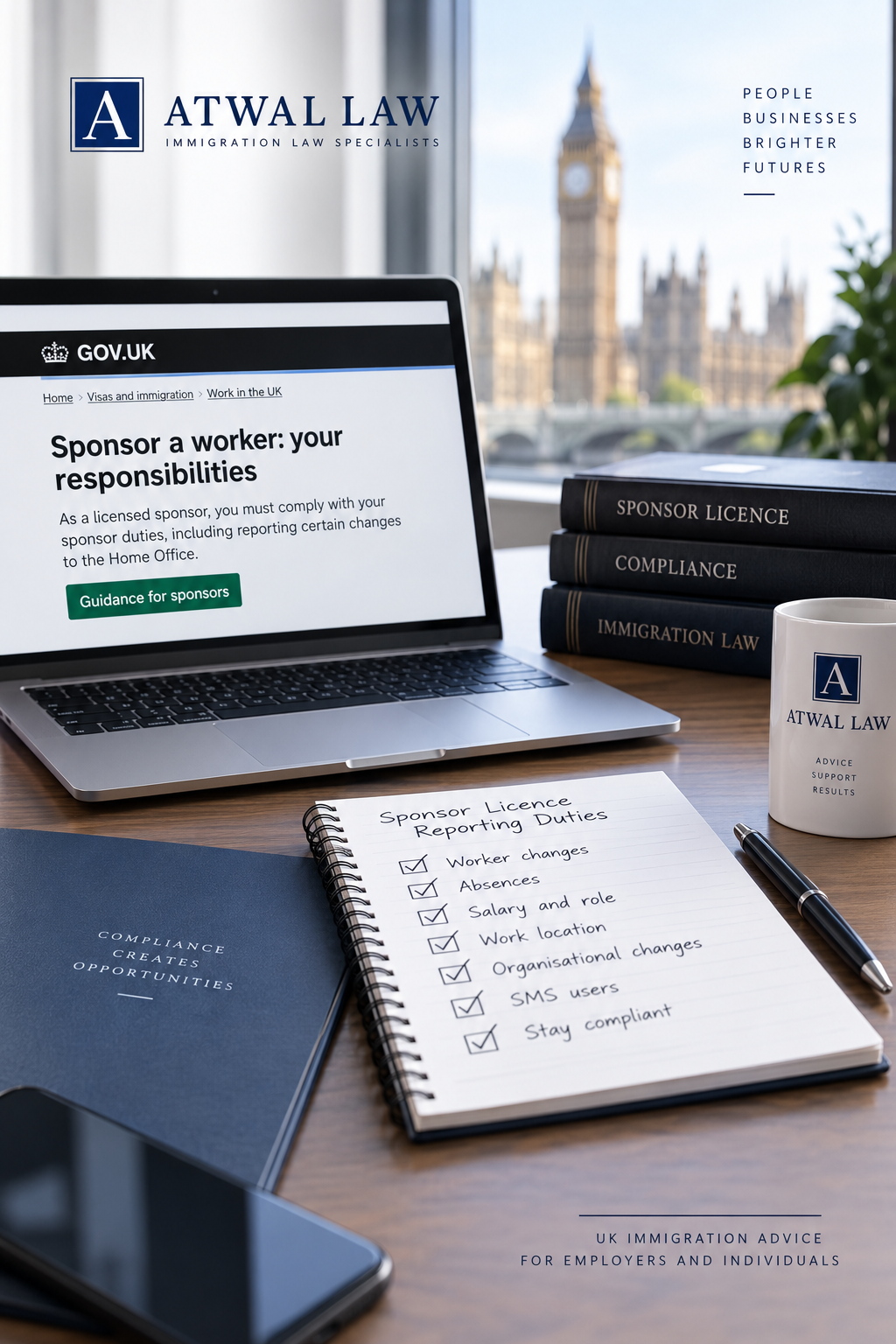
Obtaining a sponsor licence is only the beginning of an employer’s responsibilities.
Once an organisation holds a sponsor licence, it has continuing duties to the Home Office. These include reporting certain changes involving sponsored workers and reporting significant changes affecting the organisation itself.
Missing a reporting obligation can become a sponsor compliance issue. The Home Office can take action against a sponsor where it reasonably suspects that sponsor duties are not being met. Depending on the circumstances, action can include reducing the organisation’s Certificate of Sponsorship allocation, downgrading, suspending or revoking the sponsor licence.
For employers, one of the most important things to understand is what must be reported and when.
The 10 Working Day and 20 Working Day Rules
There are two important general reporting periods.
Changes to a sponsored worker’s circumstances must generally be reported within 10 working days of the relevant event occurring, unless the guidance specifies otherwise.
Changes to the sponsoring organisation covered by the organisational reporting rules must generally be reported within 20 working days, unless a different requirement applies.
These should be treated as general rules rather than universal deadlines. Employers should always consider the particular event and the relevant sponsor guidance.
1. A Sponsored Worker Does Not Start Work
Sponsors must monitor whether sponsored workers actually start the jobs for which they were sponsored.
A report is required where a sponsored worker does not start their sponsored role within 28 days of the relevant date under the sponsor guidance.
The detailed rules determining when that 28-day period begins are contained in Part 2 of the sponsor guidance.
Employers should therefore record both the expected and actual start date of every sponsored worker and investigate delays promptly.
2. Unauthorised Absence
Sponsors must report where a sponsored worker has been absent from work without permission for more than 10 consecutive working days.
Importantly, this applies even where the employer intends to continue sponsoring the worker.
The report must be made no later than 10 working days after the tenth day of absence. The sponsor should provide information including when the absence began, whether the worker has returned, attempts made to contact them where appropriate, any salary deductions and whether sponsorship will continue.
This makes effective absence monitoring particularly important for sponsor licence holders.
3. Unpaid or Reduced-Pay Absence
Another area employers need to monitor carefully is unpaid or reduced-pay absence.
The sponsor guidance identifies a worker being absent without pay, or on reduced pay, for more than four weeks in total in a calendar year as a reportable event, subject to exceptions in the sponsor guidance and particular provisions for Scale-up Workers.
The rules governing unpaid absence and salary reductions are more detailed than the reporting rule alone, so employers should check the relevant provisions before deciding whether sponsorship can continue.
4. Changes to Salary
A reduction in a sponsored worker’s salary or pay from the level stated on their Certificate of Sponsorship can trigger a reporting requirement.
The current guidance specifically requires sponsors to report where the worker’s salary or pay is otherwise reduced from the level stated on the CoS.
By contrast, sponsors do not normally need to report salary increases, although the guidance identifies an exception concerning certain sponsored pre-registration nurses and midwives who complete registration.
Employers should therefore involve whoever manages the sponsor licence before making significant changes to a sponsored worker’s salary.
A salary change should also be checked against the immigration requirements applying to the particular sponsored route. An SMS report does not itself make an otherwise impermissible salary change permissible.
5. Changes to a Sponsored Worker’s Job
Significant changes to a sponsored worker’s employment can also be reportable.
The Home Office guidance includes changes to a worker’s job role, job title or core duties, or a promotion, where the change remains within the same occupation code and the relevant conditions in Part 2 of the sponsor guidance are satisfied.
However, employers need to be careful here.
Some changes can be reported through the SMS, whereas other changes may require the worker to make a change of employment application.
Employers should therefore check the immigration consequences before implementing a substantial change to a sponsored employee’s role.
6. Changes to Work Location
A change to a sponsored worker’s normal work location is another reportable event.
This includes, for example, a worker moving to a different branch of the organisation or a different client’s site where that location was not previously recorded on their Certificate of Sponsorship.
However, employers do not need to report every temporary movement.
The Home Office says day-to-day changes, such as a worker occasionally working from another branch, another site or from home, do not need to be reported. The requirement concerns changes to the worker’s regular working pattern.
7. What About Hybrid Working?
Hybrid working does not automatically need to be reported.
The Home Office recognises arrangements where employees regularly work remotely while also regularly attending an office, branch or client site.
If a sponsored worker moves to a hybrid working pattern, the sponsor does not need to report that fact alone.
However, the employer must continue to report relevant changes to the worker’s main office work location or any new client sites and must maintain suitable records of sponsored workers’ working patterns.
This is an important distinction for employers operating flexible working arrangements.
8. Fully Remote Working Is Different
A sponsored worker becoming a contractual home worker is treated differently.
The sponsor must report through the SMS where the worker is, or will be, working entirely remotely with little or no requirement to attend the sponsor’s premises or a client site.
The Home Office also reserves the right in such circumstances to ask why sponsorship is necessary for the worker to come to the UK if, for example, the role could be performed remotely from their home country.
Employers should therefore distinguish carefully between hybrid working and a role becoming effectively fully remote.
9. When an Employer Stops Sponsoring a Worker
The Home Office must be informed when an organisation stops sponsoring a worker.
Examples given in the current guidance include where:
- the worker decides not to take up the job or the employer withdraws the offer;
- employment ends earlier than the date stated on the CoS;
- required professional registration or accreditation is withdrawn;
- the worker resigns, is dismissed or is made redundant;
- the worker obtains settlement or permission on another immigration route that does not require sponsorship; or
- certain unpaid or reduced-pay absence rules mean sponsorship cannot continue.
When reporting that sponsorship has ended, the sponsor may also need to provide the worker’s last recorded residential address, telephone number and any personal email address held by the organisation.
10. Changes to the Sponsoring Organisation
Reporting duties do not only relate to workers.
Sponsors must also report significant changes affecting the organisation.
The current guidance includes matters such as changes to the organisation’s name, address or contact details, changes to branches or linked entities, certain changes to required registrations or accreditations, stopping trading, insolvency, mergers or takeovers, changes in organisation size or charitable status where relevant, and substantial changes to the nature of the business.
Except where the guidance provides otherwise, these organisational changes must generally be reported within 20 working days after the sponsor became aware of the change.
Mergers, takeovers and changes of ownership deserve particular attention because the sponsor licence implications can be more complicated than simply updating information on the SMS.
11. Keep SMS Users Up to Date
An organisation cannot meet its reporting duties effectively if nobody is properly managing its Sponsorship Management System.
Level 1 Users carry out day-to-day sponsorship activities, including reporting worker activity and changes to the organisation.
There are also important new SMS changes in September 2026.
From 9 September 2026, sponsors can no longer appoint new Level 2 Users.
Existing Level 2 Users must either be converted to Level 1 Users, if eligible, or have their accounts deactivated by 8 March 2027. After that date, the Home Office will deactivate any remaining Level 2 accounts.
12. Multi-Factor Authentication Is Being Introduced
Mandatory multi-factor authentication, or MFA, is being introduced for SMS Users.
The rollout began on 3 September 2026 and is taking place on a phased basis. The Home Office expects mandatory MFA to be in place for all sponsors by November 2026.
For organisations granted a sponsor licence on or after 9 September 2026, mandatory MFA is enabled.
Sponsors should ensure that SMS Users’ contact information is accurate so that they can continue accessing the system when MFA is activated.
13. Inactive SMS Accounts Can Put a Licence at Risk
The Home Office has also introduced a new process for inactive SMS User accounts.
An account is considered inactive where the user has not accessed it for 12 months or more.
Where the Home Office identifies an inactive Level 1 User, action must be taken within three months of the Home Office contacting the organisation if access is to be retained.
If no action is taken, the Home Office will deactivate inactive accounts.
Crucially, if this results in an organisation having no active Level 1 Users, the Home Office says it will suspend the sponsor licence and give the organisation 28 days from the date of suspension to nominate at least one eligible Level 1 User.
If it fails to do so, the licence will normally be revoked.
The Home Office recommends that a Level 1 User accesses the SMS at least once a month.
A Practical Checklist for Employers
Whenever there is a significant HR or organisational change involving a sponsored worker, employers should ask:
- Does this change need to be reported to the Home Office?
- Is the deadline 10 working days, 20 working days or another specified period?
- Has the worker’s salary, role, duties or normal work location changed?
- Has the worker been absent without permission?
- Has there been significant unpaid or reduced-pay absence?
- Is the worker leaving employment or sponsorship ending?
- Has there been a significant change to the organisation?
- Does the worker need a new immigration application rather than simply an SMS report?
- Who is responsible for making the report?
- Has the organisation retained an appropriate record of the action taken?
Having a clear internal process can help prevent an ordinary HR event from becoming a sponsor compliance problem.
Why Sponsor Licence Reporting Matters
Sponsor licence compliance is an ongoing responsibility.
The Home Office can take action where it reasonably suspects that sponsor duties are not being met. Possible consequences include reducing a CoS allocation, downgrading the licence, suspending the licence while further enquiries are made or revoking it.
For businesses that rely on sponsored employees, the consequences of compliance failures can therefore be significant.
HR, payroll, managers and those responsible for the sponsor licence should have clear lines of communication so that relevant changes are identified before reporting deadlines are missed.
Final Thoughts
The key principle is simple: do not treat sponsor reporting as something that only needs attention when the Home Office contacts you.
Changes affecting sponsored workers generally need to be reported within 10 working days, while significant organisational changes generally fall within a 20-working-day reporting period, unless the guidance provides otherwise.
Employers should pay particular attention to absences, salary reductions, changes in duties, work locations, remote working, employees leaving and changes to the sponsoring organisation.
The September 2026 changes to SMS Users, MFA and inactive accounts also make this a particularly good time for sponsor licence holders to review who has access to their SMS and whether their internal reporting procedures are effective.
Atwal Law advises businesses on sponsor licence applications, sponsor compliance and the sponsorship of overseas workers.
If you are concerned about a reporting deadline, a change affecting a sponsored employee or your organisation’s sponsor licence compliance, contact Atwal Law for advice.
This article is for general information only and does not constitute legal advice. Sponsor guidance and the Immigration Rules can change, and the correct reporting or immigration action will depend on the individual circumstances.