

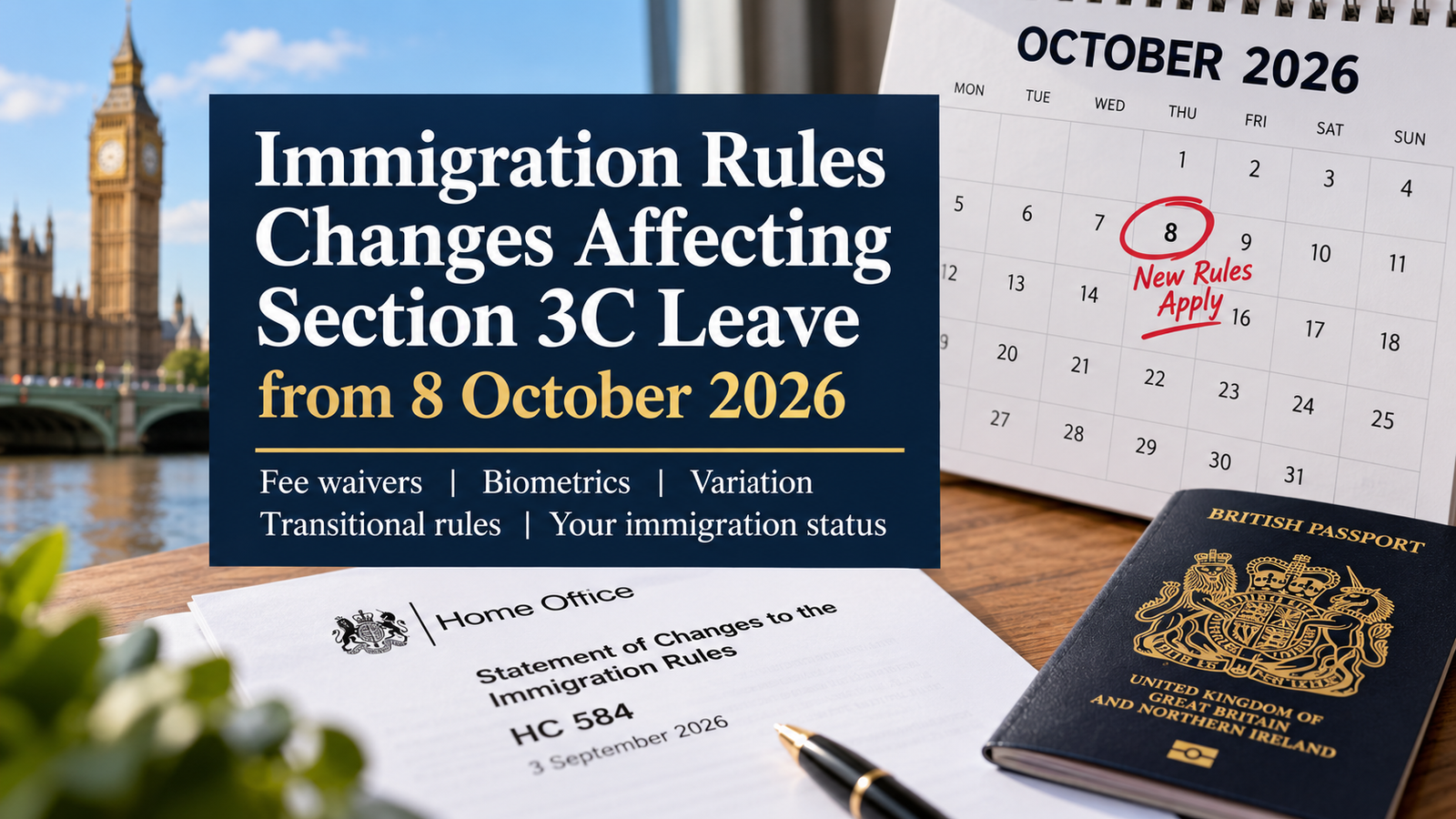
Important changes to the UK Immigration Rules affecting Section 3C leave will come into force on 8 October 2026.
The changes are particularly relevant to people who make a fee waiver request before submitting an immigration application, as well as applicants who vary an existing immigration application while it is still pending.
The changes also make clear that varying an application does not restart the period for providing biometrics. Failure to provide biometrics within the applicable period can affect the validity of the application, potentially creating serious consequences for someone relying on Section 3C leave.
There are also transitional provisions for certain applications made before 8 October 2026.
The changes are contained in Statement of Changes to the Immigration Rules HC 584, published on 3 September 2026.
What is Section 3C leave?
Section 3C of the Immigration Act 1971 can extend a person’s existing leave where they make an application to vary their leave before that leave expires and the application remains undecided when their existing leave expires.
The application must ultimately be valid for Section 3C leave to arise, although certain defects may be capable of being corrected through the Home Office validation process.
In simple terms, imagine your visa expires on 30 November and you make an appropriate application to extend your stay on 20 November.
If the Home Office has not decided the application by 30 November, Section 3C may extend your existing leave while you wait for a decision.
You do not normally need to make a separate application for Section 3C leave.
Why is Section 3C leave important?
Section 3C prevents a person who has made an in-time application from simply becoming an overstayer because their existing permission expires while the Home Office is still considering their case.
Importantly, the conditions attached to the person’s previous leave generally continue during Section 3C leave.
For example, if the person’s previous immigration permission allowed them to work, their right to work can generally continue while they have Section 3C leave, subject to the conditions of their previous permission.
Section 3C leave can also continue in certain circumstances while an in-country appeal or administrative review is pending.
However, Section 3C does not automatically protect everybody who submits an immigration application.
The timing and validity of an application can be crucial.
What changes on 8 October 2026?
The Home Office published Statement of Changes to the Immigration Rules HC 584 on 3 September 2026.
Among the changes are amendments affecting situations where applicants may seek to rely on Section 3C leave.
The relevant changes concern:
- fee waiver requests and the date of an immigration application, and
- biometric deadlines where an existing immigration application is varied.
These changes take effect on 8 October 2026, subject to the transitional provisions discussed below.
Change 1: Fee waiver requests and changing immigration routes
This could be particularly important for applicants whose existing immigration permission is approaching expiry.
A person who cannot afford the Home Office application fee may, on certain immigration routes and subject to the relevant requirements, be able to make a fee waiver request.
The date on which that fee waiver request is made can be extremely important.
Under paragraph 34G of the Immigration Rules, where the relevant requirements are met, the date of the fee waiver request can be treated as the date of the subsequent immigration application.
Home Office fee waiver policy already required the subsequent application to be the application for which the fee waiver had been requested. HC 584 now puts the relevant requirement into the Immigration Rules and introduces an express consequence where an application is instead made on another route.
Under the amended paragraph 34G(4), the subsequent application must be made on the same immigration route specified in the fee waiver request in order to benefit from the earlier application date.
Where the applicant receives a fee waiver decision, the relevant application must normally be submitted within 10 working days of receipt of that decision in order to benefit from the earlier application date.
The amended Rules also address circumstances where an applicant pays for and submits an application on the same route before receiving the fee waiver decision.
What if you apply on a different immigration route?
From 8 October 2026, new paragraph 34G(5) expressly provides that where an applicant makes an application on a different route from the one specified in the fee waiver request, the application date will be the date that different application is actually submitted.
The applicant will not be able to rely on the earlier fee waiver request date as the date of that different-route application.
For someone whose existing immigration permission has expired in the meantime, that distinction could have serious consequences for their immigration status and their ability to rely on Section 3C leave.
An example
Imagine somebody’s immigration permission expires on 20 October 2026.
On 12 October 2026, after the new Rules have taken effect, they make a fee waiver request stating that they intend to apply on a particular family or human rights route.
Their existing permission then expires while the fee waiver request is being considered.
Following the fee waiver decision, they decide instead to make an application on a different immigration route.
Under new paragraph 34G(5), the date of that different-route application will be the date on which it is actually submitted. The applicant cannot simply use the earlier fee waiver request date as the date of that different-route application.
Depending on the circumstances, this could affect whether the applicant can rely on Section 3C leave and therefore whether their previous immigration permission has continued.
This is why applicants should take particular care before changing immigration routes where their existing permission has expired or is close to expiry.
What about applications made before 8 October 2026?
HC 584 contains important transitional provisions.
For the relevant Part 1 changes, where an application for permission to stay, a claim, or an application for administrative review is made before 8 October 2026, it will be decided in accordance with the Immigration Rules in force on 7 October 2026.
This means that applicants with existing matters should not automatically assume that the new provisions apply simply because the Home Office makes its decision after 8 October.
However, there may be more complicated situations where the transitional provisions require careful consideration.
For example, a fee waiver request is not itself an application for permission to stay. Questions may therefore arise where a fee waiver request is made before 8 October but the subsequent immigration application is submitted after the new Rules take effect.
There may also be questions about the position where an application made before 8 October is varied after 8 October.
Applicants falling into these transitional situations should not assume that either the old or new provisions automatically apply without considering the particular facts and applicable Rules.
Can you still vary an immigration application?
In appropriate circumstances, an applicant may be able to vary an immigration application before the Home Office has decided it.
However, variation can have important consequences and the rules are technical.
The Home Office explanatory memorandum states that the fee waiver amendment is intended to address cases where applicants use a fee waiver request relating to a human rights application to extend their leave under Section 3C and subsequently vary to a non-human rights application.
Anyone considering changing the basis of an application while their existing leave is close to expiry, or has already expired, should therefore consider obtaining immigration advice before doing so.
Change 2: Varying an application does not restart the biometric period
The second important change concerns biometrics.
Applicants who are required to provide biometric information must do so within the applicable period.
Where an applicant varies a pending immigration application, they should not assume that the variation gives them a fresh biometric deadline.
From 8 October 2026, existing policy is expressly reflected in the Immigration Rules through new paragraph 34BB(2A).
The new provision makes clear that where an applicant varies a previous application, the biometric information must still be provided within the period specified in relation to the previous application.
In other words, varying your application does not restart the biometric clock.
Missing the biometric deadline can affect validity
This is particularly important because the biometric requirement is not simply an administrative formality.
Compliance with the applicable biometric requirement forms part of the validity requirements for the application.
Therefore, where an applicant varies an application but fails to provide the required biometric information within the period applicable to the original application, this can result in the application being invalid.
That can potentially have serious knock-on consequences for a person who is relying on the application to maintain their immigration status under Section 3C.
Applicants should therefore continue to comply with their existing biometric requirements even where they subsequently vary their application.
Why is the Home Office making these changes?
In its explanatory memorandum accompanying HC 584, the Home Office says the fee waiver change is intended to combat abuse where applicants make a human rights application in order to extend their leave under Section 3C and then vary that application to a non-human rights application.
The biometric amendment places the existing policy concerning the biometric enrolment period expressly into the Immigration Rules.
What happens if my visa expires while my application is pending?
This is one of the most common concerns for immigration applicants.
Where an appropriate application to vary leave is made before existing permission expires and the requirements for Section 3C are met, Section 3C can extend the person’s existing leave while the Home Office considers the application.
However, whether Section 3C applies depends upon the individual circumstances.
Particular care may be required where:
- your application was submitted close to or after your visa expiry date;
- there is a question about whether your application is valid;
- you have submitted a fee waiver request;
- you are considering changing immigration routes;
- you are considering varying an existing application;
- you have not provided your biometrics;
- your application has been refused;
- you are considering an appeal or administrative review; or
- you are considering travelling outside the UK while your application is pending.
Can I continue working under Section 3C?
Where Section 3C applies, the conditions attached to the person’s previous immigration permission generally continue.
Therefore, if your previous immigration permission allowed you to work, that right can generally continue while you have Section 3C leave, subject to the same conditions that applied previously.
Section 3C does not give someone a new or wider right to work than they previously had.
Can I travel while I have Section 3C leave?
Applicants need to be particularly careful about travelling outside the UK while relying on Section 3C leave.
Section 3C leave ends when a person leaves the UK.
Travelling outside the UK while an immigration application is pending can therefore have serious consequences for both the application and the person’s immigration position.
Anyone considering travelling while relying on Section 3C leave should obtain advice before doing so.
Is there a 14-day grace period after my visa expires?
There is sometimes confusion about a supposed 14-day grace period for overstayers.
There is no general rule allowing everyone to remain lawfully in the UK for 14 days after their visa expires.
The Immigration Rules contain limited circumstances under paragraph 39E in which a short period of overstaying may be disregarded. This can include certain circumstances where an application is made within 14 days of permission expiring and there was a good reason beyond the control of the applicant or their representative why the application could not be made in time.
However, this does not mean that the person automatically receives Section 3C leave during that period.
An application made after a person’s immigration permission has expired does not itself create Section 3C leave simply because it was submitted within 14 days.
Applicants should therefore deal with their immigration position before their existing permission expires wherever possible.
Should I apply before 8 October 2026?
The fact that these changes take effect on 8 October 2026 does not mean that everybody should rush to submit an immigration application before that date.
Importantly, HC 584 contains transitional provisions under which relevant applications, claims and administrative review applications made before 8 October 2026 are generally considered under the Rules in force on 7 October 2026.
Whether the old or new provisions apply can nevertheless become more complicated where, for example, a fee waiver request is made before 8 October but the subsequent immigration application is made afterwards, or an existing application is subsequently varied.
The position should therefore be considered on the facts of the individual case rather than assuming that submitting something before 8 October will necessarily secure treatment under the previous Rules.
Immigration advice in Coventry
At Atwal Law, we advise individuals and families on UK immigration matters including leave to remain, family and private life applications, fee waiver applications, settlement and other immigration applications.
If you are based in Coventry, Birmingham or elsewhere in the UK and your immigration permission is approaching expiry, it is important to understand your position before making or changing an application.
This can be particularly important where you are relying on Section 3C leave to maintain your lawful immigration status while the Home Office considers your application.
Need advice about Section 3C leave or an expiring visa?
If your UK visa is due to expire, you have an immigration application pending, you are considering varying an application, or you need to make a fee waiver request, you can contact Atwal Law for immigration advice.
Getting the timing, validity and type of application right can be particularly important where your continued lawful status in the UK depends upon Section 3C of the Immigration Act 1971.
This article provides general information only and does not constitute legal advice. Immigration law and Home Office policy can change, and advice should always be obtained on individual circumstances.