UK Spouse Visa Financial Requirements 2026: A Guide for Coventry Families
Are you applying for a UK spouse visa in Coventry or planning to bring your husband, wife or partner to the United Kingdom?
One of the most important parts of a UK spouse or partner visa application is meeting the Home Office financial requirement.
Many applications involve difficulties not because the sponsoring partner has insufficient income, but because the wrong financial category is used, the supporting evidence is incomplete or the applicant misunderstands the requirements.
Atwal Law is a Coventry-based, Immigration Advice Authority (IAA) regulated immigration practice. We provide professional immigration advice to individuals and families throughout Coventry, Birmingham and the wider UK.
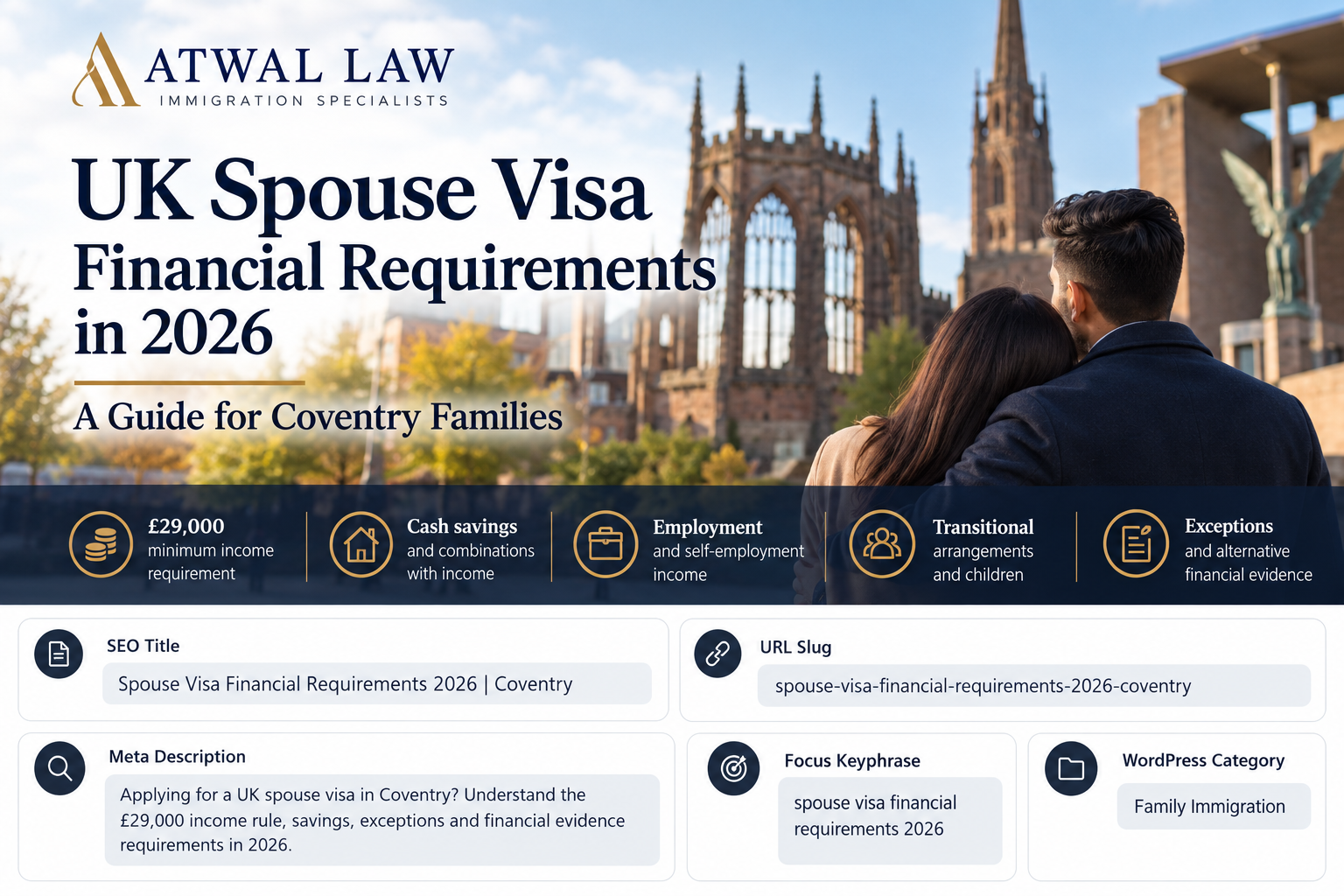
In this guide, we explain the financial requirements for UK spouse and partner visas in 2026, including the £29,000 minimum income requirement, transitional arrangements, cash savings, self-employment and exemptions for certain benefits.
What Is the Minimum Income Requirement for a UK Spouse Visa in 2026?
For most new applications under the spouse or partner route, the minimum income requirement is £29,000 per year.
This requirement was introduced on 11 April 2024 and remains the standard threshold in October 2026.
The previously proposed increase to £38,700 has not been implemented.
Applicants must generally demonstrate that they meet the financial requirement using permitted sources of income, qualifying cash savings or an allowed combination.
However, the £29,000 threshold does not apply to every applicant.
Different arrangements may apply to certain people who first applied under the partner route before 11 April 2024 or whose sponsoring partner receives specified disability or carer’s benefits.
It is therefore essential to identify the correct financial requirement before submitting an application.
Applicants Who First Applied Under the Partner Route Before 11 April 2024
Some applicants benefit from transitional financial arrangements.
Where an applicant first made a qualifying application as a partner before 11 April 2024 and is extending permission with the same partner, the applicable minimum income requirement may remain £18,600 per year.
These transitional arrangements can also cover eligible applicants who first applied as a fiancé(e) or proposed civil partner before 11 April 2024.
Where relevant dependent children are included, the financial requirement may increase by:
- £3,800 for the first relevant child.
- £2,400 for each additional relevant child.
For extensions under the transitional rules, the total requirement is capped at £29,000.
Not every child triggers an additional amount. For example, British or Irish citizen children and certain children with settled or pre-settled status are excluded from the additional child calculation.
The applicable requirement depends on the applicant’s immigration history, previous application dates and family circumstances.
Example: An applicant who first applied under the qualifying partner route before 11 April 2024 and is extending with the same partner may remain subject to the £18,600 requirement rather than £29,000, provided the transitional conditions are satisfied.
What Income Can Be Used to Meet the Spouse Visa Financial Requirement?
The Home Office permits several sources of income under Appendix FM and Appendix FM-SE.
These include qualifying employment income, self-employment income, certain non-employment income, pensions and cash savings.
The applicable evidential requirements depend on the source of income.
Category A: Employment With the Same Employer for at Least Six Months
Category A generally applies where the relevant person has been employed by the same employer for at least six months at the date of application.
The calculation depends on whether the employment is salaried or non-salaried and whether the relevant income requirements have been satisfied throughout the qualifying period.
Typical supporting documents include:
- Six months of relevant payslips.
- Corresponding bank statements.
- An employer’s letter confirming the required employment details.
Additional evidence may be necessary depending on the circumstances.
A common mistake is assuming that a current salary above £29,000 automatically satisfies Category A, even where the salary has only recently increased.
Category B: Employment for Less Than Six Months or Variable Employment History
Category B may apply where the relevant person has been with their current employer for less than six months or where the employment circumstances require assessment under this category.
It generally involves two separate financial assessments.
The first concerns qualifying employment income at the date of application.
The second concerns actual qualifying income received during the preceding 12 months.
Both applicable requirements must be satisfied.
Example: A Coventry sponsor who started a new job three months ago may need to demonstrate both an appropriate current level of income and sufficient qualifying earnings during the previous 12 months.
The correct calculation depends on the employment history and the evidence available.
Category C: Non-Employment Income
Certain forms of non-employment income may count towards the financial requirement.
These can include qualifying rental income, dividends and other permitted sources.
The relevant income must satisfy the rules governing its calculation and supporting evidence.
Applicants should not assume that every payment received into a bank account qualifies as income under Appendix FM-SE.
Category D: Cash Savings
Qualifying cash savings may be used to meet the financial requirement, either alone or in combination with certain permitted income sources.
The savings must satisfy the relevant ownership, availability, source and evidential requirements.
Category E: Pension Income
Qualifying pension income may also be used to satisfy the financial requirement.
This can include certain state, occupational and private pensions.
The applicable evidence depends on the type of pension and the relevant Home Office requirements.
Categories F and G: Self-Employment and Specified Limited Companies
Different financial rules apply where the sponsor or applicant relies on qualifying self-employment income or income from a specified limited company.
Category F generally considers income from the most recent full financial year.
Category G generally considers the average income from the most recent two full financial years.
These categories can require substantial financial documentation, including tax returns, accounts and other evidence.
Company directors should be particularly careful because income from a specified limited company may be assessed differently from ordinary salaried employment.
Can Cash Savings Be Used Instead of Income?
Yes. Qualifying cash savings can be used to meet the spouse visa financial requirement.
For most applications under the standard £29,000 threshold, the calculation is:
£16,000 + (2.5 × £29,000) = £88,500
This means that an applicant relying entirely on qualifying cash savings would generally need £88,500.
For eligible applicants subject to the transitional £18,600 requirement, with no additional child-related amount, the corresponding figure is:
£16,000 + (2.5 × £18,600) = £62,500
These calculations concern the cash savings requirement for the relevant limited-leave partner application. Different calculations can apply in other circumstances, including settlement.
Cash Savings Requirements at a Glance
| Applicable income threshold | Savings required if relying on savings alone |
|---|---|
| £29,000 | £88,500 |
| £18,600 transitional requirement | £62,500 |
How Long Must Savings Be Held?
Cash savings must generally have been held for at least six months before the application.
The funds must be under the control of the applicant, their partner or both, and must satisfy the relevant requirements concerning availability and lawful source.
Specific provisions may apply where qualifying savings come from the sale of an asset or another permitted arrangement.
Applicants should check the requirements carefully before relying on recently transferred funds.
Can Income and Savings Be Combined?
In certain circumstances, qualifying cash savings can be combined with permitted income to meet the financial requirement.
Example:
A sponsor earns £25,000 annually and is subject to the standard £29,000 minimum income requirement.
The annual shortfall is £4,000.
The cash savings calculation is:
£16,000 + (2.5 × £4,000) = £26,000
Therefore, qualifying cash savings of £26,000 may be sufficient to address that income shortfall, provided all other applicable requirements are met.
However, applicants should be aware that cash savings cannot generally be combined with self-employment income under Categories F or G, or with income from a specified limited company assessed under those categories, to meet the minimum income requirement.
The rules on combining different financial sources are detailed and should be considered before applying.
What If the Sponsor Receives Disability or Carer’s Benefits?
Where the sponsoring partner receives certain specified benefits, the standard minimum income requirement does not apply.
Instead, the applicant must satisfy the applicable adequate maintenance requirement.
Qualifying benefits include, among others:
- Personal Independence Payment (PIP).
- Disability Living Allowance (DLA).
- Attendance Allowance.
- Carer’s Allowance.
- Armed Forces Independence Payment.
- Constant Attendance Allowance.
- Certain other qualifying disability, carer and service-related payments specified in the Immigration Rules.
The adequate maintenance assessment considers the family’s available income and relevant housing costs.
The applicant must also satisfy the applicable accommodation requirements.
Receiving a qualifying benefit does not automatically guarantee that the financial requirement is met.
The correct assessment depends on the household’s circumstances and the relevant Home Office guidance.
What Happens If You Cannot Meet the Financial Requirement?
Some applicants may still have options where the standard financial requirement cannot be met.
For example, circumstances involving a qualifying child, family life or human rights considerations may require assessment under other provisions of Appendix FM.
In certain cases, decision-makers must consider whether refusal would produce consequences that engage the relevant human rights provisions.
However, being married to a British citizen does not automatically exempt an applicant from the financial requirement.
Where an application is granted under alternative family life provisions, the route to settlement may differ from the standard five-year partner route.
These matters require careful individual assessment.
Common Financial Evidence Mistakes in Spouse Visa Applications
Using the Wrong Income Threshold
Some applicants incorrectly assume that everyone must satisfy £29,000, while others rely on the previous £18,600 threshold without qualifying for transitional arrangements.
Missing Payslips or Bank Statements
Applicants may meet the income requirement but fail to provide the prescribed supporting evidence.
Using the Wrong Employment Category
Category A and Category B involve different assessments. Selecting the wrong category can lead to an incorrect calculation.
Misunderstanding Self-Employment Income
Self-employed applicants and company directors may need to rely on completed financial years and provide detailed financial documentation.
Relying on Savings That Do Not Qualify
Savings may fail to satisfy the rules because of insufficient holding periods, inadequate evidence or restrictions on combining income sources.
Overlooking Specified Benefits
Applicants sometimes assume that a sponsoring partner receiving disability or carer’s benefits must still meet the £29,000 income requirement.
In qualifying cases, the adequate maintenance provisions may apply instead.
How Atwal Law Can Help With Spouse Visa Applications in Coventry
Atwal Law provides immigration advice to individuals and families across Coventry and throughout the United Kingdom.
Our practice is regulated by the Immigration Advice Authority (IAA) and led by Nick Atwal, who has more than 17 years of immigration law experience.
Nick is also a postgraduate lecturer in UK Immigration Law at London Metropolitan University.
We assist with:
- Spouse and partner visa applications.
- Spouse visa extensions.
- Assessing financial eligibility.
- Reviewing employment and self-employment evidence.
- Calculating qualifying cash savings.
- Applications involving specified benefits.
- Applications involving previous immigration difficulties.
We aim to provide clear, practical advice tailored to each client’s circumstances.
Remote consultations are available for clients in Coventry and elsewhere in the UK.
Frequently Asked Questions About Spouse Visa Financial Requirements
Is the UK spouse visa income requirement £29,000 or £38,700 in 2026?
The standard minimum income requirement remains £29,000 for most new partner applications. The previously proposed increase to £38,700 has not been implemented.
Can I extend my spouse visa using the £18,600 requirement?
Potentially. Eligible applicants who first applied under the relevant partner provisions before 11 April 2024 and are extending with the same partner may qualify for transitional arrangements.
How much savings do I need for a spouse visa?
For a standard application subject to the £29,000 income requirement, the savings-only figure is generally £88,500.
For eligible applicants subject to the £18,600 transitional requirement, without an additional child-related amount, the equivalent figure is £62,500.
Can I combine my salary and savings?
In many cases, yes. However, the permitted combinations depend on the income category and the applicable Immigration Rules.
Can a self-employed person sponsor their spouse?
Yes, potentially. Qualifying self-employment income may be relied upon, provided the relevant financial and evidential requirements are met.
What if my partner receives PIP or Carer’s Allowance?
Where the sponsoring partner receives a qualifying specified benefit, the adequate maintenance requirement may apply instead of the standard minimum income threshold.
Can Atwal Law help with spouse visas in Birmingham as well as Coventry?
Yes. Atwal Law provides immigration advice to clients in Coventry, Birmingham and throughout the UK, including through remote consultations.
Speak to Atwal Law About Your UK Spouse Visa Application
If you are preparing a UK spouse or partner visa application in Coventry, obtaining professional advice can help you identify the correct financial requirements and supporting evidence.
Atwal Law provides immigration advice on spouse visas, partner visa extensions and applications involving complicated financial circumstances.
Contact Atwal Law today to arrange your free initial 10-minute consultation.
Important Information
This article provides general information about the UK spouse and partner visa financial requirements as at October 2026.
Immigration Rules and Home Office guidance may change. The government has also proposed wider settlement reforms, but proposals should not be treated as law until implemented.
Applicants should check the requirements applicable on the date of their application and obtain advice based on their individual circumstances.