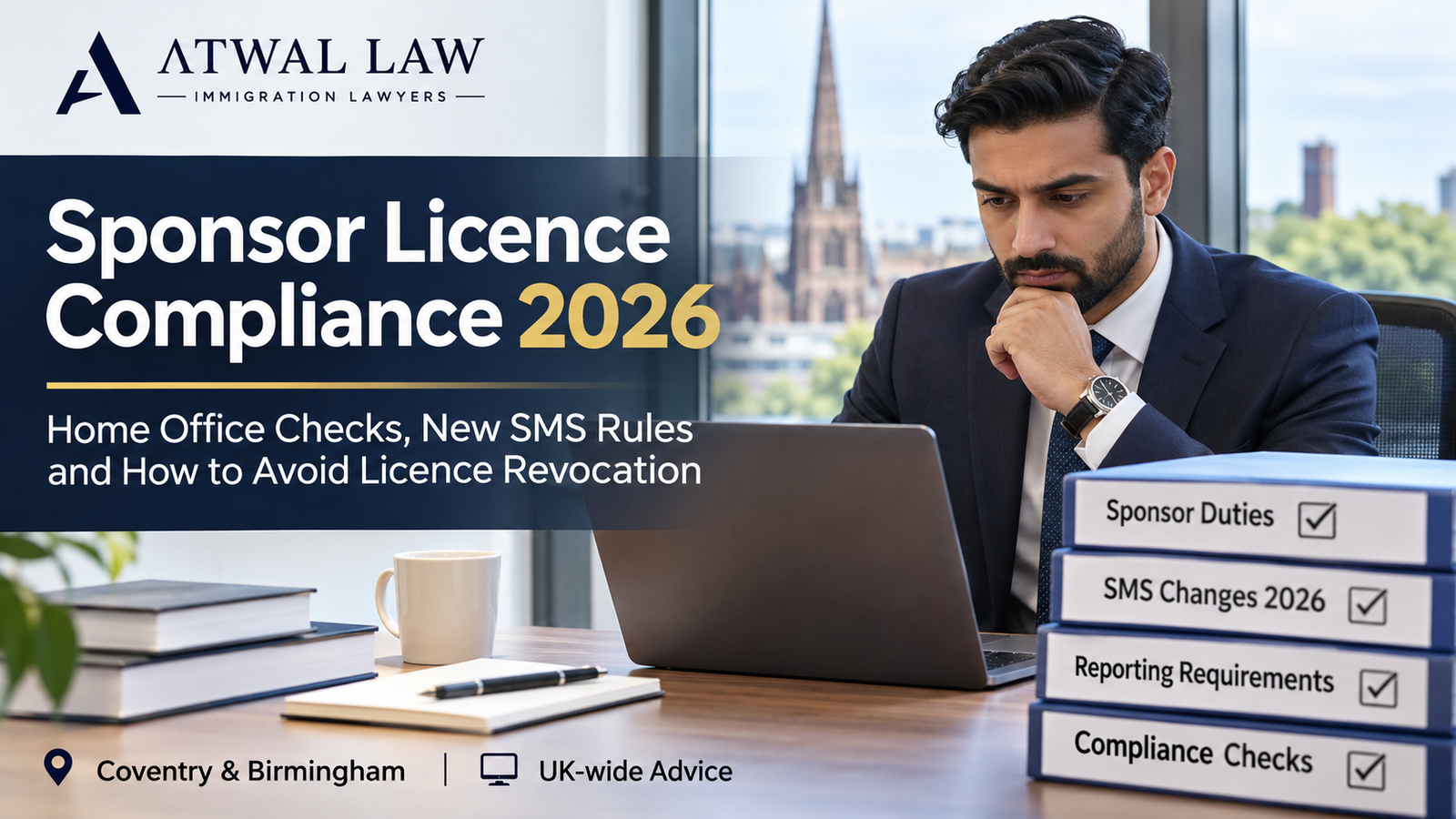
Sponsor Licence Compliance 2026: Home Office Checks, New SMS Rules and How to Avoid Licence Revocation
Updated: 20 November 2026
Holding a UK sponsor licence allows businesses to recruit eligible overseas workers, but it also comes with significant legal and administrative responsibilities.
In 2026, the Home Office introduced important changes affecting sponsor licence holders, including mandatory multi-factor authentication, the removal of Level 2 Sponsor Management System (SMS) users and new procedures concerning inactive accounts.
For employers in Coventry, Birmingham and across the UK, understanding these changes is essential. Failure to comply with sponsor duties can lead to Home Office investigations, suspension or even revocation of a sponsor licence.
This guide explains what employers need to know about sponsor licence compliance in 2026, how UK Visas and Immigration (UKVI) conducts compliance checks and the practical steps businesses can take to protect their sponsor licence.
1. What Is Sponsor Licence Compliance?
Sponsor licence compliance refers to the duties and responsibilities imposed on organisations authorised by the Home Office to sponsor overseas workers.
Once a sponsor licence has been granted, the employer must continue to satisfy the relevant sponsorship requirements.
These obligations include:
- Keeping accurate records of sponsored workers.
- Monitoring attendance and immigration status.
- Reporting relevant changes through the Sponsor Management System.
- Ensuring sponsored workers undertake genuine roles consistent with their Certificates of Sponsorship.
- Complying with relevant employment law and immigration requirements.
- Cooperating with Home Office compliance checks.
Importantly, these duties continue throughout the life of the sponsor licence, not simply when a worker is first sponsored.
The Home Office may assess compliance even where an employer has not previously experienced any immigration difficulties.
2. What Are the Main Sponsor Licence Reporting Duties?
One of the most common areas of concern for employers is failing to report changes within the required time limits.
Changes affecting sponsored workers
Employers must normally report specified changes affecting sponsored workers within 10 working days of the relevant event.
Examples include:
- A sponsored worker failing to start employment within the relevant permitted period.
- A sponsored worker leaving employment earlier than expected.
- Certain changes to a worker’s role, duties, salary or working arrangements.
- Unauthorised absence exceeding the relevant reporting threshold.
For example, where a sponsored worker is absent without permission for more than 10 consecutive working days, the employer must normally report this no later than 10 working days after the tenth consecutive working day of absence.
Not every change can simply be reported through SMS. Some changes may require a fresh Certificate of Sponsorship and a new immigration application.
Changes affecting the sponsoring organisation
Significant organisational changes must generally be reported within 20 working days, although specific exceptions and separate procedures apply.
Examples may include:
- Changes to the business address or contact details.
- Changes to the organisation’s structure.
- Changes involving branches or linked entities.
- Certain mergers, acquisitions or transfers of business ownership.
Some changes can affect whether the existing sponsor licence remains valid.
Employers should therefore obtain appropriate advice before making significant organisational changes involving sponsored workers.
3. Important Sponsor Licence Changes Introduced in 2026
The Home Office updated its sponsor guidance on 28 August 2026, introducing several important changes affecting sponsor licence management.
Mandatory multi-factor authentication for SMS users
Mandatory multi-factor authentication (MFA) is being phased in from 3 September 2026.
MFA provides an additional layer of security when accessing the Sponsor Management System.
Employers should ensure that their Level 1 users have accurate and up-to-date contact details and can access their accounts.
Failure to take the required action may result in users losing access to SMS, potentially affecting the employer’s ability to manage sponsorship duties.
Level 2 SMS users are being removed
From 9 September 2026, sponsors can no longer appoint new Level 2 users.
Existing Level 2 users must be converted to Level 1 users, where eligible, or have their accounts deactivated by 8 March 2027.
This is an important deadline for businesses that rely on Level 2 users to assign Certificates of Sponsorship or report worker activity.
Employers should review their SMS users well before the deadline.
Inactive SMS user accounts
The Home Office has also introduced procedures to identify and remove inactive SMS user accounts.
Where a user has not accessed SMS for an extended period, the Home Office may require the sponsor to verify or update the relevant account details.
Failure to take the necessary action within three months of being contacted can result in the account being deactivated.
If this leaves an organisation without an active Level 1 user, the sponsor licence may be suspended. Failure to appoint an eligible Level 1 user within the permitted period can lead to revocation.
Inactive sponsor licences
The August 2026 guidance also introduced a dedicated section concerning inactive sponsor licences.
Although most sponsor licences no longer require renewal every four years, holding a licence indefinitely does not remove the employer’s compliance responsibilities.
The Home Office has indicated that it intends to manage licences held by organisations that are no longer actively sponsoring workers.
Businesses that no longer require their licence should consider whether surrendering it is appropriate.
4. What Happens During a Home Office Sponsor Licence Compliance Visit?
The Home Office can conduct sponsor compliance checks before granting a licence or after a licence has been issued.
These checks may be announced or unannounced.
An employer does not necessarily need to be suspected of wrongdoing before a compliance check takes place.
During a visit, UKVI officers may examine:
Right to work records
Whether the employer has carried out the required right to work checks and retained appropriate evidence.
Sponsored worker files
Whether the employer maintains the records required by Appendix D of the sponsor guidance.
Recruitment and job duties
Whether sponsored workers are undertaking genuine roles that correspond with the duties and occupation codes recorded on their Certificates of Sponsorship.
Salary and payroll information
Whether sponsored workers receive the salary required under the relevant immigration rules.
The Home Office may compare sponsorship information with HMRC payroll data and other available records.
Attendance monitoring
Whether the employer has effective systems to monitor attendance, identify unauthorised absences and report relevant changes.
Sponsor management procedures
Whether the Authorising Officer, Level 1 users and relevant HR personnel understand the organisation’s sponsor duties.
Businesses should be able to demonstrate how their compliance systems operate in practice, rather than relying solely on written policies.
5. Can the Home Office Suspend or Revoke a Sponsor Licence?
Yes. Where the Home Office identifies compliance failures, it may take enforcement action.
Depending on the seriousness of the issues, possible outcomes include:
Downgrading to a B-rating
An employer may be downgraded from an A-rating to a B-rating and required to comply with a Home Office action plan.
Sponsor licence suspension
The Home Office may suspend a licence while investigating potential breaches.
Sponsor licence revocation
Serious breaches can result in the licence being revoked.
Revocation normally prevents the employer from continuing to sponsor workers under that licence and can have significant consequences for affected employees.
The employer may also face a cooling-off period before becoming eligible to apply for another sponsor licence, subject to the applicable rules and exceptions.
For sponsored workers, revocation may lead to the cancellation of their immigration permission, depending on their circumstances.
This is why employers should address compliance concerns promptly rather than waiting for a Home Office investigation.
6. How Can Employers Prepare for a Sponsor Licence Audit?
A sponsor licence compliance audit can help employers identify weaknesses before they become serious problems.
Businesses should consider reviewing the following areas.
Sponsored worker records
Check that the required documents are retained and can be produced when requested.
Right to work procedures
Confirm that staff responsible for recruitment understand the correct right to work checking procedures.
Salary and occupation codes
Ensure sponsored workers’ actual duties, salaries and working hours remain consistent with the relevant sponsorship requirements.
SMS reporting
Check whether reportable events have been identified and reported within the relevant deadlines.
Key personnel
Confirm that the Authorising Officer and Level 1 users remain eligible, available and familiar with their responsibilities.
Internal compliance training
Ensure relevant managers and HR staff understand their obligations and know when to escalate potential compliance concerns.
There is no universal requirement to conduct a sponsor licence audit at a fixed interval. However, periodic reviews are a sensible way to identify and address risks.
7. Are Small Businesses Subject to the Same Sponsor Licence Rules?
Yes.
Sponsor licence compliance requirements apply to licensed sponsors regardless of whether they are large organisations or small businesses.
A small construction company, restaurant, care provider or other eligible business sponsoring overseas workers must comply with the relevant Home Office requirements.
Smaller employers may face particular challenges where immigration compliance responsibilities are handled by a single director or manager.
However, the size of the organisation does not remove its reporting, record-keeping or monitoring duties.
8. Frequently Asked Questions About Sponsor Licence Compliance
Can UKVI visit my business without warning?
Yes. The Home Office may conduct unannounced compliance visits. Employers should therefore maintain accurate records and functioning compliance systems at all times.
How often does the Home Office audit sponsor licence holders?
There is no fixed interval requiring the Home Office to visit every sponsor. Checks may take place at different stages and may be informed by risk assessments or other information.
What happens if I forget to report a change on SMS?
Failure to report a relevant change can constitute a breach of sponsor duties. The consequences depend on the nature and seriousness of the failure, including whether there is a wider pattern of non-compliance.
Can a sponsor licence be revoked if no workers are currently sponsored?
A sponsor licence can be subject to Home Office action even where no workers are currently sponsored. The precise consequences depend on the circumstances and the applicable sponsor guidance.
What happens to employees if a sponsor licence is revoked?
Sponsored workers may face cancellation of their immigration permission, subject to the applicable rules and individual circumstances. They may need to secure alternative sponsorship or consider another immigration route.
Do I need an immigration lawyer for a sponsor licence compliance audit?
There is no general legal requirement to instruct an immigration lawyer for an internal compliance audit.
However, professional advice can help employers identify reporting failures, record-keeping issues and other risks before a Home Office inspection.
9. Sponsor Licence Compliance Advice in Coventry and Birmingham
Atwal Law provides UK immigration advice to employers in Coventry, Birmingham and throughout the UK.
We assist businesses with:
- Sponsor licence applications.
- Sponsor licence compliance reviews.
- Home Office compliance visit preparation.
- SMS reporting obligations.
- Skilled Worker sponsorship requirements.
- Sponsor licence suspension and revocation matters.
- Immigration advice concerning sponsored workers.
Our aim is to help employers understand their responsibilities, identify potential risks and maintain effective immigration compliance procedures.
Whether you are a small business sponsoring your first overseas worker or an established organisation managing several sponsored employees, obtaining appropriate advice can help protect your business and workforce.
Contact Atwal Law for professional sponsor licence and immigration compliance advice.
Atwal Law | UK Immigration Lawyers
Coventry | Birmingham | UK-wide online advice
Website: https://atwallaw.co.uk
Disclaimer: This article provides general information based on the Immigration Rules and Home Office sponsor guidance available as at 20 November 2026. It does not constitute legal advice. Sponsor duties and immigration requirements may change, and individual circumstances should be assessed before action is taken.